Low-latency display
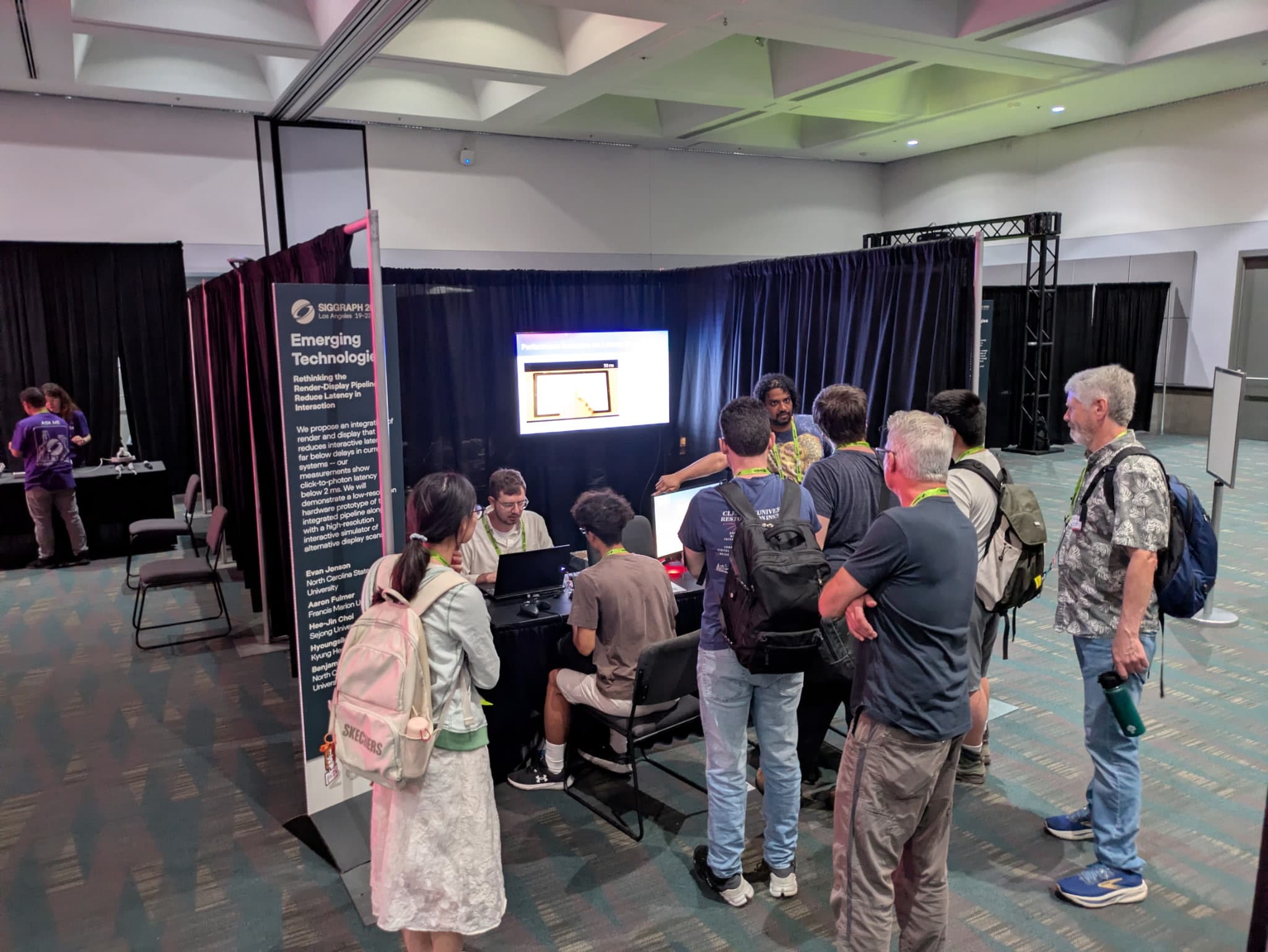
Near-zero latency display system. MSCS thesis research. Image from Emerging Technologies (E-Tech) SIGGRAPH 2026, LA.
Overview
Near-zero latency display
The general render-display pipeline we use today was built for recorded media, where latency doesn't exist, and modern interactive systems still inherit those latency-free assumptions. We proposed an alternative: tightly integrating render and display to prioritize interactive latency.
The problem
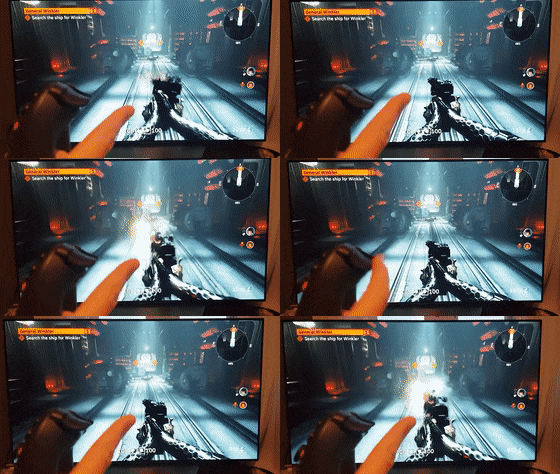
Latency you can feel
Interactive latency is the total, perceived delay from a user's input to the moment photons change on the display. I measured this delay using NVIDIA's LDAT (Latency and Display Analysis Tool) and compared our system against the standard approach.
My role
MSCS Thesis
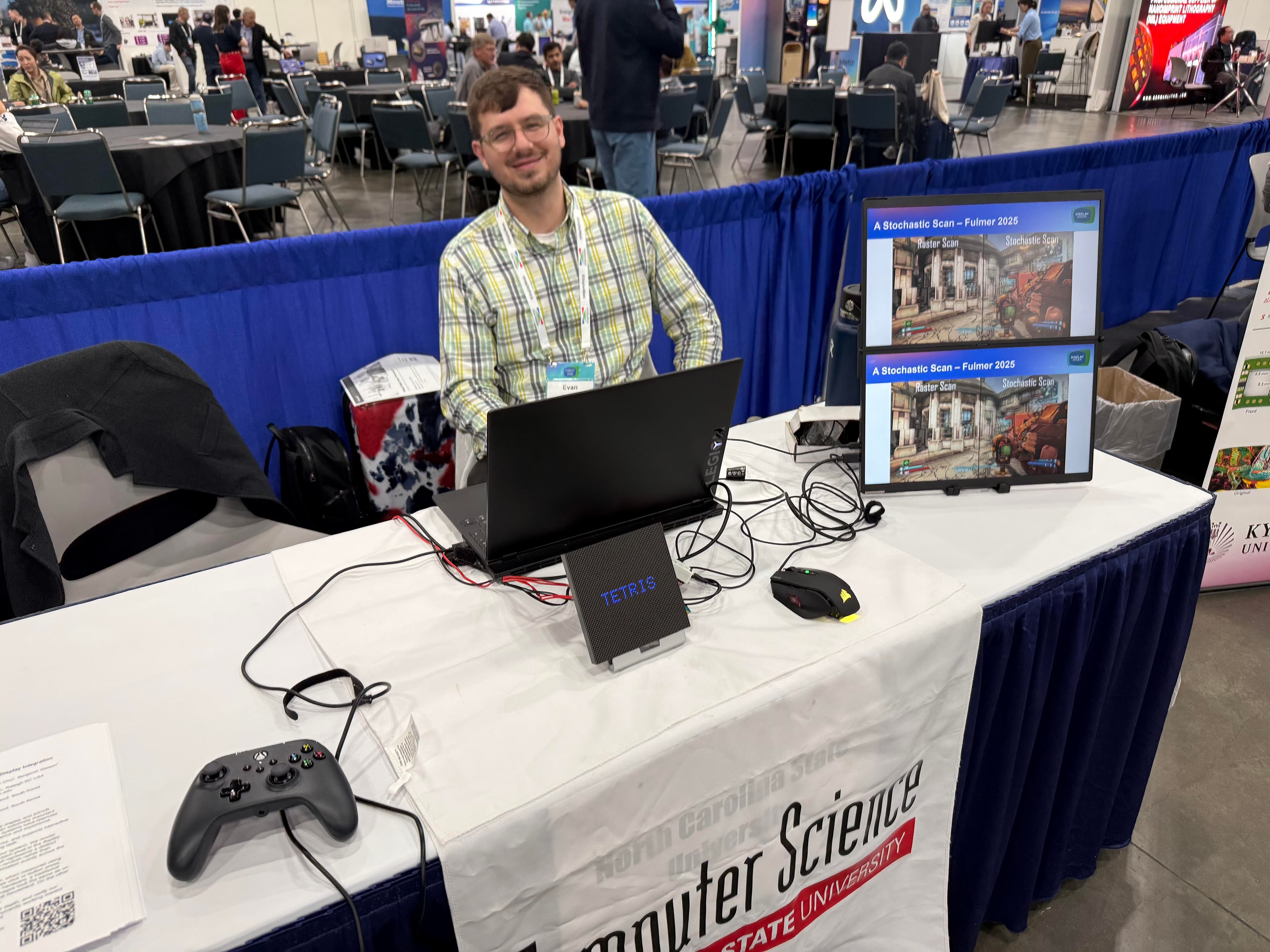
Thesis lead — design, implementation, evaluation. Image from Display Week's Innovation Zone (I-Zone), SID 2026, LA.
Solution
The approach
Frames cause latency. Our system takes advantage of a property of image-order renderers (ray tracing), where pixels can be displayed the instant they're computed. Interactive latency is minimized by sampling and updating pixels framelessly, individually and just-in-time, along a stochastic scan pattern.
Results
Results
In a controlled experiment with render speed throttled to 60 Hz, we achieved click-to-photon latency under 2 ms across the entire panel on average. This is only possible due to our unique ability to update pixels throughout the frame.
Future
Looking forward
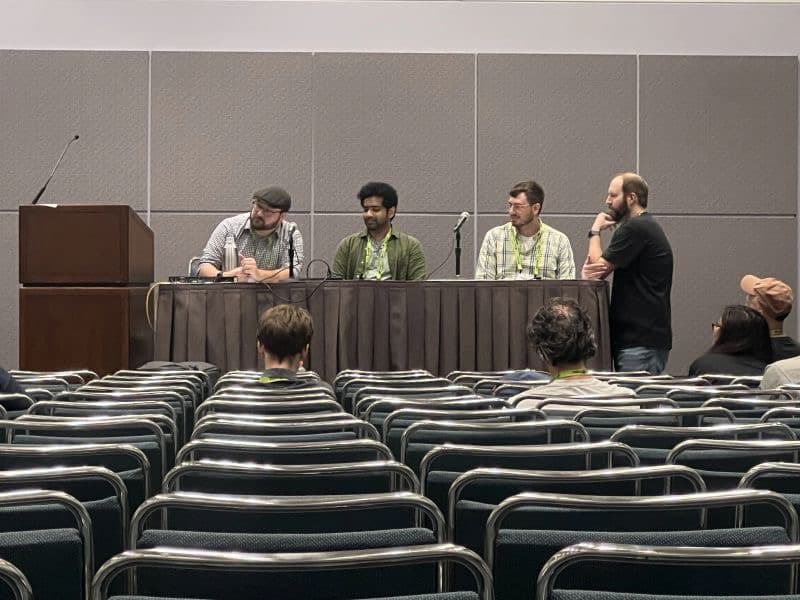
This has been an incredible project to work on, and it's taken me to some exciting places. I'm eager to keep improving on the system. Image from PRICE technical workshop, SIGGRAPH 2026, LA.